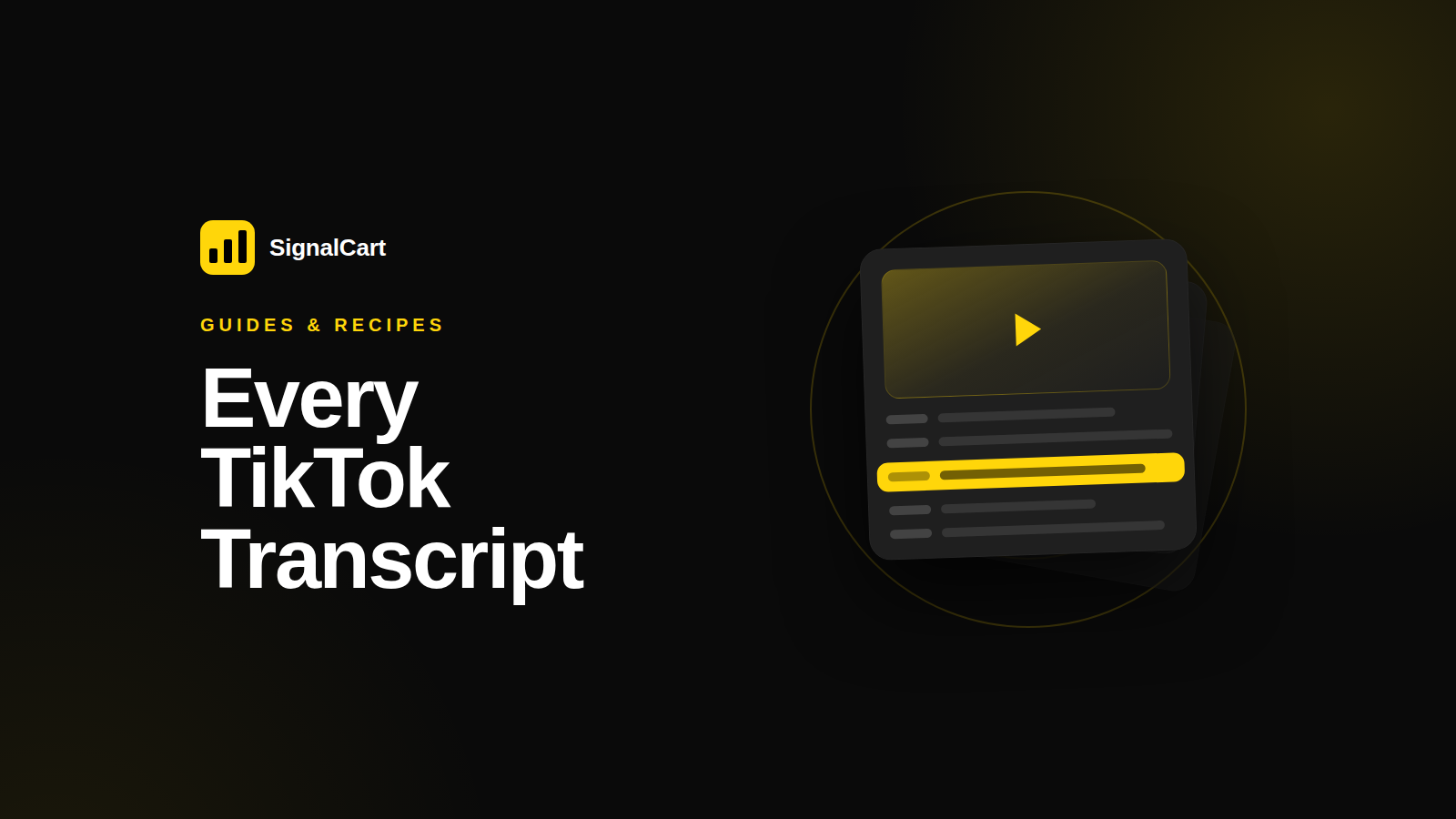
A TikTok transcript is the machine-readable text of a video's spoken content. A TikTok transcript API returns those transcripts at scale, with metadata like creator, hashtags, and publish date, so teams can batch-extract, deduplicate, and join transcripts to commerce and creator analytics instead of copying links one at a time.
A TikTok transcript is the machine-readable text of what is spoken in a TikTok video, and a TikTok transcript API is the interface that returns that text for many videos at once. Most teams first encounter the concept through a free web tool: paste a link, wait a few seconds, copy the result. That workflow is fine for a single clip and unworkable for a catalog of thousands.
This guide explains what a transcript actually contains, how bulk extraction works in production, and how to evaluate providers on accuracy, throughput, and cost. It also shows where transcripts connect to creator and commerce analytics for sellers, brands, marketers, agencies, and developer teams. Figures that cannot be verified against a public source are marked rather than estimated.
Why a TikTok Transcript API Beats One-Off Transcript Generators
The limits of free URL-to-text tools
Free transcript generators solve a reading problem, not a data problem. They accept one URL at a time and return plain text with little surrounding context. There is no batch queue, no documented rate limit, and no service commitment if the page changes shape next month.
The metadata gap matters more than the speed gap. A copied transcript tells you what a creator said, but not who the creator is, how the video performed, which hashtags it used, or when it was published. Without those fields, you cannot join transcripts to advertising performance or product data. You also cannot deduplicate near-identical scripts across a creator's back catalog.
Repeatability is the third limitation. Manual copy and paste produces no audit trail, no consistent schema, and no way to refresh a dataset six months later. Analysts end up rebuilding the same spreadsheet, and engineering teams inherit a process that cannot be scheduled or monitored.
What an API adds at scale
An API converts a manual task into a repeatable data pipeline. You submit a list of public video URLs or IDs, and the service returns structured records in JSON, with optional TXT, SRT, or VTT export for subtitle-style use. Timestamped segments let you align speech to on-screen events, cuts, or product reveals.
Automatic language detection helps teams process multi-market creator rosters without pre-sorting submissions. When the response schema is stable, transcripts can be joined to creator profiles, engagement metrics, and hashtag history using a single key. That join is what turns text into competitive intelligence.
Commercial use cases
Ad creative analysis is a common entry point. Teams extract scripts from high-performing organic and paid videos, tag hooks, offers, and calls to action, and compare them against their own creative library. Creator vetting is another: transcripts reveal how a creator talks about products, whether claims are cautious or aggressive, and how often sponsored content appears.
UGC script research, TikTok Shop product pitch mining, content repurposing, and trend scanning through the TikTok Research API round out the list. A seller can identify the recurring objections creators raise about a product category, then rewrite listings and ad copy to address them. A marketer can convert a spoken script into newsletter, blog, and email copy without transcribing by hand.
What to Extract from a TikTok Video: Transcripts, Captions, and Script Data
Four different text layers
The word "transcript" covers several distinct outputs, and buyers should confirm which one a vendor returns. The spoken-word transcript comes from speech recognition on the audio track. Native TikTok captions may be creator-uploaded or auto-generated by the platform, and they do not always match the audio exactly. On-screen text is a separate visual layer, often used for hooks and product names. Video metadata is the fourth layer: identifiers, authorship, timing, and performance.
These layers fail in different ways. A speech-to-text transcript handles a quiet talking-head clip well but may miss on-screen price information. Platform captions can be incomplete when a creator edits them manually. A useful API tells you which layer produced each field.
Structured fields worth requesting
Field | What it gives you |
|---|---|
Video ID and URL | A stable key for joins, deduplication, and re-runs |
Creator handle and profile reference | Grouping transcripts by creator for vetting and script libraries |
Hashtags and caption text | Topical context that the spoken audio may not state |
Publish date | Trend windows, seasonal comparison, and script evolution over time |
Engagement statistics | Weighting transcripts by views, likes, comments, and shares |
Transcript text | Full-text search, keyword extraction, and copy analysis |
Timestamped segments | Alignment to visual events and subtitle generation |
Language and confidence scores | Quality triage before transcripts enter a warehouse |
Quality factors that decide usability
Speech recognition on short-form video is harder than on clean podcast audio. Background music, fast delivery, strong accents, overlapping speakers, and dialect variation all reduce accuracy. Punctuation and casing affect whether a transcript is readable enough to quote internally or reuse in marketing copy.
Timestamp alignment deserves separate scrutiny. A transcript can be accurate word for word yet drift several seconds from the video timeline, which breaks subtitle export and segment-level analysis. Confidence scores help: they let a team route low-quality records to human review instead of treating every transcript as equally reliable.
The available sources do not specify which languages a given provider supports, transcript length limits, or extraction rate limits, so those items are until confirmed in a vendor's documentation.
How a TikTok Transcript API Works at Scale
The request-to-export workflow
Submit public TikTok URLs or video IDs, usually in batches rather than one request per video.
Receive a job identifier immediately, because extraction is asynchronous and time-bound.
Poll for status or receive a callback when the batch completes.
Download structured results in JSON, with TXT, SRT, or VTT where subtitle formats are needed.
Load the output into a warehouse or BI tool, then join it to creator, product, and performance tables, just as you would when pulling TikTok video metrics into dashboards.
Asynchronous design is not a technical detail; it shapes how teams plan work. A batch job that completes in minutes suits daily creative monitoring. A backfill of a creator's full catalog should be scheduled once and cached, not repeated on every dashboard refresh.
The pipeline behind the endpoint
Behind the endpoint, a typical pipeline retrieves the public video, extracts audio, runs speech-to-text, and aligns results with available captions. Normalization then cleans punctuation and spacing, while deduplication prevents the same video from being charged or stored twice. Caching handles repeat requests for popular videos.
Retries and rate-limit handling determine whether a large batch finishes cleanly. Videos are sometimes removed, made private, or region-restricted between submission and retrieval. A well-built service reports those failures explicitly rather than silently returning empty transcripts.
Operational metrics buyers should request
Accuracy measured on a sample set the buyer supplies, not only on vendor-chosen examples.
Median and tail latency for a batch of a known size.
Supported languages and how confidence scores behave across them.
Cost per 1,000 videos, including how failed or duplicate jobs are billed.
Daily throughput limits and whether they can be raised on request.
Reliable Public-Data Extraction Without Getting Blocked
Teams often ask whether it is possible to collect data from TikTok without getting blocked. The practical answer is that reliable social media scraping comes from infrastructure design, not from a single clever request pattern. Managed retrieval spreads load across regions, throttles requests, queues work, retries transient failures, and falls back to alternative routes when one path degrades.
That architecture is expensive to build in-house for a team whose actual goal is creative analysis. It is also the part most likely to break without warning, which is why uptime reporting and clear failure states matter as much as transcript quality.
Compliance boundaries to confirm in writing
Public data only: no private accounts, direct messages, or restricted content.
A documented data retention policy and deletion process.
Legal review of intended use, including advertising and republication rights and the relevant court rulings on scraping TikTok data.
Respect for platform terms and applicable local regulation.
SignalCart states that it uses public data only across its API coverage, which includes Amazon, TikTok Shop, Instagram, and YouTube. Buyers should still confirm how each vendor defines public and how that definition is enforced in code.
How reliability is measured
Ask for uptime history, error rates by endpoint, and regional availability. Duplicate suppression should be demonstrable: submitting the same video twice should not produce two billed records. Failed video jobs should return a reason code so teams can distinguish a deleted video from a temporary outage.
Choosing the Best TikTok Transcript API for Your Team
A commercial evaluation checklist
Bulk coverage: batch submission, job status, and callback support.
Transcript accuracy: verified against your own sample of videos.
Timestamp and subtitle support: SRT and VTT export with aligned segments.
Language coverage: detection plus quality across your target markets.
Metadata richness: creator, hashtags, publish date, and engagement fields.
Pricing model: per video, per minute, or per job, with failure handling defined.
Documentation and support: schema stability, handling of breaking TikTok API versions, and response times.
Pricing comparisons deserve the same discipline as any data purchase. A broader comparison of coverage, pricing, and reliability for sellers, developers, and agencies is useful background before shortlisting vendors.
Can you collect social media data without coding?
Partly. Developer API access offers the most control, schema flexibility, and integration depth, and it puts credential management across TikTok and YouTube in your own hands. Low-code alternatives include dashboards, spreadsheet imports, and automation connectors that call an API on a schedule. These options suit marketing teams that need recurring exports rather than custom pipelines.
The trade-off is granularity. Third-party TikTok analytics dashboards rarely expose timestamped segments or confidence scores, which limits downstream analysis. Teams often start low-code and migrate to direct API access once transcript volume grows.
Run a proof of concept first
Select 50 to 100 real videos that represent your categories, languages, and audio conditions.
Benchmark transcript accuracy manually, including punctuation and speaker handling.
Verify metadata joins against your existing creator and product tables.
Calculate cost per usable transcript, counting failures and duplicates.
Confirm that export formats match your warehouse or subtitle workflow.
A small, honest test reveals more than a feature list. It also creates an internal benchmark you can reuse when contracts come up for renewal.
Putting TikTok Transcripts to Work with SignalCart
Transcripts become far more useful when they sit next to commerce and creator data. SignalCart positions itself as e-commerce and social media data in one API covering Amazon, TikTok Shop, Instagram, and YouTube, with public data only. That combination lets teams analyze creator GMV, trending products, hashtags, and video performance alongside the scripts themselves.
Related SignalCart guides cover adjacent workflows: scraping Instagram posts, Reels, and creator profiles with a social media API free tier, including endpoints, pagination, and rate-limit handling; and a brand monitoring approach that turns hashtags, comments, and mentions into real-time insight. The same join logic applies to transcripts.
Workflows by role
Sellers and TikTok Shop operators: mine product pitch language, compare it with review language, and refine listings and offers — the qualitative complement to mapping TikTok Shop metrics for BI platforms.
Brands: run creator due diligence at scale by reviewing scripts, claim patterns, and category history together.
Marketers and agencies: build a library of winning ad scripts, then tag hooks and offers for reuse across campaigns.
Developers and data teams: schedule batches, export structured transcripts to a warehouse, and join them to product and performance tables.
Getting started
Review the API documentation and confirm the response schema for transcripts and metadata.
Run a sample batch against a small, representative set of public videos.
Export structured transcripts into your warehouse and join them to creator and product records.
Combine with Amazon, Instagram, and YouTube data where cross-platform comparison adds value.
Analysis, not transcription, is where the return sits. A transcript library that is searchable, timestamped, and connected to commerce metrics turns creative research into a repeatable intelligence function. Teams that build that link early tend to spend less time collecting text and more time deciding what to do with it.
FAQ
How can I get a TikTok video transcript?
Use an API endpoint that accepts a video URL or ID and returns the spoken text. For many videos, submit a batch job and store each transcript with its metadata.
Can you scrape data from TikTok without getting blocked?
Not reliably with naive scraping. Production teams use managed APIs with rate limits, retries, and rotating infrastructure to reduce blocking and keep extraction stable.
What is the best tool for social media scraping?
There is no universal best tool; choose based on platforms covered, metadata depth, throughput limits, and compliance. For TikTok transcripts specifically, evaluate transcript accuracy, batch support, and cost per 1,000 videos.
Can you scrape social media without coding?
Yes, some no-code tools and dashboard products support basic exports. At scale, however, transcript and metadata pipelines usually require API access or developer support for scheduling and deduplication.

by Alejandro Martín Vega, Technology & Ecommerce Intelligence Journalist
Alejandro Martín Vega is a Spanish technology journalist specializing in ecommerce intelligence, digital marketplaces, and competitive research. Based in Madrid, he explores Amazon seller strategies, TikTok Shop ecosystems, advertising intelligence, and emerging retail technologies. His writing focuses on turning complex marketplace data and industry developments into practical insights that help businesses, marketers, and online sellers make informed decisions.