A data pipeline web scraping API aggregation dashboard breaks at ingestion and aggregation, not in the UI: TikTok Shop endpoint, field, and token changes silently null metrics, break joins, and drift creator GMV totals. Teams need schema validation, fallback scraping, versioned normalization, and reconciliation checks before charts mislead sellers, agencies, and clients.
TikTok Shop API changes affect a data pipeline web scraping API aggregation dashboard most at the ingestion and aggregation layers, not at the dashboard itself. That is the practical answer for sellers, agencies, and developers planning social commerce analytics: the visible chart is the last place a breaking change appears, and often the first place anyone notices it.
Why TikTok Shop API Changes Matter for E-commerce Data Analytics
TikTok Shop analytics products sit on top of an API that the platform actively revises. Trend trackers, creator GMV leaderboards, and product research dashboards all depend on upstream endpoints, field definitions, and access rules that can change without much notice. When they do, the dashboard does not usually crash. Instead, a metric column goes blank, a product join fails, or a creator total drifts because one field stopped arriving.
Three groups feel that risk differently. TikTok Shop sellers and creators check daily dashboards to make restocking, pricing, and affiliate decisions; a missing creator GMV figure can distort their view of what is working. Agencies reporting to clients face reconciliation problems when a number changes between exports. Developers maintaining ingestion jobs absorb the operational cost: failed token refreshes, deprecated endpoints, and null fields that surface only after a client asks why a chart looks wrong.
The core tension is simple. Competitive intelligence products promise continuity, but they inherit the instability of the sources beneath them. API updates rarely break the dashboard interface. They break the ingestion and aggregation layers that feed it. That is why pipeline design matters more than any single endpoint, and why data accuracy is an architecture problem as much as a reporting problem.
The table below shows verified SignalCart Analytics marketplace data. It illustrates the kind of aggregated metrics a pipeline must keep continuous through upstream changes: product titles, prices, units sold, and verified GMV.
Rank | Product Title | Brand | Price | Units Sold | Verified GMV |
|---|---|---|---|---|---|
#1 | SEESE Cordless Pressure Washer Gun, 1000 PSI Portable Electric Washer for V... | SEESE Cordless Pressure Washer Gun, 1000 PSI Portable Electric Washer for Vehicle, Driveway & Deck | $31.38 | 72,451 | $2,273,223.33 |
#2 | Toplux Magnesium Complex 8 Essential Magnesium Supplement... | Toplux | $15.05 | 120,384 | $1,811,749 |
#3 | Voyage Nova | Rosey Fruity Floral | Extrait De Parfum 50ml/100ml | Long Las... | Voyage | $23.00 | 310,440 | $1,770,934.8 |
#4 | Ninja SLUSHi Professional Frozen Drink Maker - FS301... | Ninja SLUSHi Professional Frozen Drink Maker | $336.67 | 4,983 | $1,677,623.19 |
#5 | Shark Rocket Pet Pro Cordless Stick Vacuum - IZ162HC... | Shark Rocket Pet Pro Cordless Stick Vacuum | $276.81 | 5,903 | $1,602,548.52 |
Those rows are not just product records. Each one is the output of an ingestion path, a normalization step, and an aggregation rule. If a product ID changes format at the source, row #1 can disappear from a trending products list even though nothing about the product changed. If creator attribution fields shift, a creator GMV leaderboard can undercount a brand's affiliate performance. The marketplace trend is real; the data pipeline has to prove it reliably.
What Are the Key TikTok Shop API Updates in 2026?
Specific changelogs should always be checked against TikTok Shop Partner Center documentation, because partner access rules can differ by region, tier, and app category. The useful pattern is not a single update. It is the recurring categories of change that data teams should expect and design for.
First, authentication and token lifecycle updates. OAuth token expiry, refresh behavior, and scope changes can stop a job before any data is requested. A token that refreshes correctly in one environment may fail in another because scopes were narrowed or an app permission was reclassified. For a pipeline, authentication is not a one-time setup task. It is a monitored dependency with its own failure modes.
Second, endpoint deprecations and version bumps. When a version retires, field names, pagination rules, and response envelopes can change. A product ID that was a string may become a different identifier, or a page-size limit may drop. These are not cosmetic changes. They alter join keys and backfill logic. Teams that hard-code endpoint assumptions discover the change through blank widgets, not through release notes.
Third, shifts in which fields are exposed versus restricted to higher partner tiers. A field available to an authorized seller may not be available to a third-party analytics vendor at the same scope. If tier gating changes, a metric column can silently null out. The dashboard still renders. The value is gone. Schema expectations therefore need versioning and validation on every release.
Fourth, throttling, quota, and rate-limit adjustments. These change a pipeline's polling strategy, backfill windows, and freshness guarantees. A job that once completed within a refresh cycle may now need queueing, prioritization, or incremental syncs. Event-driven options such as webhooks can reduce polling pressure, but they introduce delivery retries, ordering issues, and event replay requirements. Confirmed API behavior should be documented per endpoint; inferred capacity assumptions should be treated as analysis, not fact.
The practical implication is consistent. Any partner-tier gating or field-scope change can produce a null column without an error code. Data teams need contract tests that assert field presence, type, null rate, and value range. They need alerts when a metric stops moving. And they need a release process that treats TikTok Shop API updates as planned schema changes, not as surprises.
How Breaking Changes Flow Through a Data Pipeline: Scraping, Aggregation, Dashboard
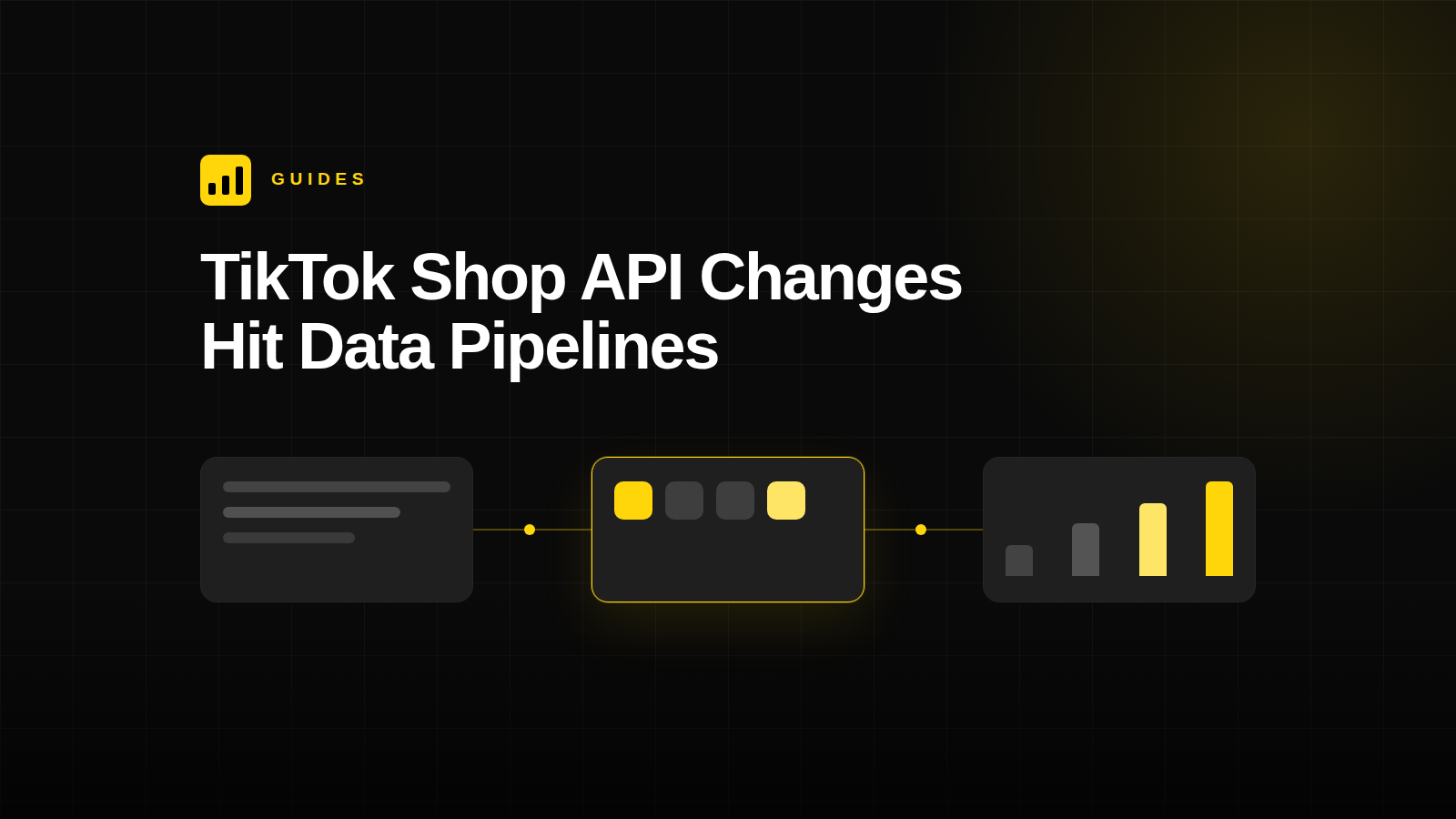
A modern social commerce pipeline has three layers. Ingestion collects data through web scraping and API aggregation. Transformation normalizes products, shops, and creators into shared entities. The dashboard layer surfaces aggregated metrics such as trending products, creator GMV, and advertising performance. Failures move through those layers in predictable ways.
At ingestion, the first symptom is a dropped field or a failed request. An API field may stop arriving, a public page selector may change, or a rate limit may cut a polling window short. If the pipeline treats a missing field as an empty string, the failure becomes invisible. If it treats it as a hard error, the job stops and freshness suffers. Neither is good without monitoring.
At aggregation, join keys shift. Product IDs, shop IDs, and creator IDs are the glue between sources. When one changes format, rows split, duplicate, or orphan. A creator GMV estimate may be attributed to the wrong creator handle, or a product may fall out of a category rollup. These errors are harder to see because the dashboard may still show plausible numbers. Anomaly alerts and reconciliation checks are the detection layer.
At the dashboard, the user sees stale or blank widgets. That is the visible failure, but it is rarely the root cause. Dashboard-first analytics products often hide this machinery from the buyer. That is convenient until a client asks why a leaderboard changed overnight. A data API model exposes more of the pipeline, which gives developers and agencies control but also responsibility for monitoring.
Hybrid ingestion is the resilience pattern that keeps an aggregation dashboard continuous during partner API transitions. Use the official API where it is stable and permitted. Use public web scraping, often through a dedicated scraping API, for public-facing surfaces that the API does not cover. Normalize both into one schema. Label the source and the freshness of each metric. When the API changes, only one adapter should need repair.
A dashboard is a promise of continuity. A pipeline is the machinery that has to keep that promise through every upstream revision.
What Data Can You Extract from the TikTok Shop Open API — and What Still Needs Web Scraping?
Authorized API access typically supports shop-level catalog and product data, order and settlement data, affiliate and creator performance fields, and operational details tied to a seller's own account. That is valuable for seller insights and for first-party reporting. It is also bounded. Third-party or competitor-level visibility is limited, and some fields are reserved for higher partner tiers or specific use cases.
Raw API access leaves gaps that matter for marketplace research. Cross-platform trending product signals are one example. A product may trend on TikTok Shop because of a creator video, then appear on Amazon or Instagram with different velocity. Creator GMV estimates are another. Public-facing creator pages and affiliate disclosures can provide signals that an authorized seller API does not expose for competitors. Review velocity, ad surfaces, and livestream activity are similar: they are often public or semi-public, but they are not neatly packaged inside a single seller-scoped endpoint.
That is where public data collection and aggregation fill in. A web scraping tool can observe public product pages, creator profiles, and visible engagement signals. API aggregation can combine those observations with authorized seller data. Together they support a dashboard that covers marketplace trends rather than only one shop's operations.
The compliance line must be clear. Public data only. No private buyer information. No attempt to bypass access controls. There is a real distinction between what an API authorizes and what a public scraping layer may legitimately observe, and the legality of scraping TikTok data, as addressed in court rulings, is part of that boundary. Data intelligence platforms should document that distinction, respect platform terms, and avoid presenting scraped estimates as reported facts. A label such as estimated versus reported is not cosmetic; it is part of data accuracy.
How Data Intelligence Platforms Should Adapt: Architecture and Operations Checklist
Platforms should put an adapter or abstraction layer in front of every source. A TikTok Shop API revision should change one connector, not every dashboard query. The adapter translates external fields into internal entities, applies validation rules, and records source metadata. Versioned schemas and automated contract tests for critical metrics turn silent breakage into a visible release event.
Operational hygiene matters just as much. The following checklist is a practical starting point for teams maintaining a data pipeline web scraping API aggregation dashboard stack:
Monitor per endpoint. Track success rate, latency, quota consumption, and null rate separately for each API resource and scraper target. A global pipeline health check hides local failures.
Fail over deliberately. If an official API endpoint is unstable, fall back to public-data collection where permitted, and mark the metric source and freshness. Do not blend sources without labels.
Cache last-known-good values. Show the last verified value with a timestamp when a refresh fails. A stale but labeled metric is better than a blank chart with no explanation.
Run backfill jobs. After an outage or a schema fix, repair historical gaps so trend lines and week-over-week comparisons remain valid.
Test schema contracts. Assert that key fields exist, types match, and null rates stay within expected bounds. Treat field-scope changes as contract changes.
Alert on anomalies. Compare creator GMV, unit sales, and trending product ranks against recent baselines. A sudden flat line can be a data failure, not a market shift.
Reconcile joins. Validate product, shop, and creator identifiers across sources. Log orphan rates and duplicate rates as first-class metrics.
The product side of adaptation is communication. Users need to know data freshness and coverage. They need estimated metrics labeled as estimates and reported metrics labeled as reported. They also need realistic expectations for how quickly a new API field reaches the dashboard. A release note that says a field is now available is useful only if the aggregation logic, backfill, and display layer are ready too.
For agencies, this translates into client trust. For sellers, it translates into seller insights that do not vanish during a partner API transition. For developers, it translates into fewer midnight incidents and clearer ownership. Competitive intelligence depends on continuity, and continuity is an operational discipline.
Choosing a Social Commerce Data API: Questions to Ask Before You Rebuild
Buyers evaluating a social commerce data API should ask a short set of practical questions. Does the vendor cover Amazon, TikTok Shop, Instagram, and YouTube in one schema, or does each platform require a separate integration? How does the vendor communicate upstream breaking changes? Is aggregation to dashboard-ready metrics included, or is raw data the only output? How are gaps backfilled after an outage? Can the vendor distinguish reported data from estimated data?
Source coverage matters because marketplace trends rarely stay on one platform. A TikTok Shop product may have an Amazon counterpart. A creator may cross-post to Instagram and YouTube. One schema reduces the join burden and makes cross-platform competitive intelligence feasible. Communication matters because a vendor that does not publish change notices is shifting integration risk onto the buyer. Backfill matters because historical continuity is what makes trend analysis credible.
There are two common models. Dashboard-first analytics products, such as Kalodata, FastMoss, and Jungle Scout-style research tools, package the pipeline behind a user interface. They can be fast to adopt and useful for sellers who want answers rather than infrastructure. The trade-off is visibility: when the underlying source changes, the buyer sees the symptom but not the cause. A data API model gives developers and agencies raw plus aggregated access they can own. It is better when the buyer needs to embed metrics into internal tools, combine sources, or audit freshness.
SignalCart fits the second model. It provides e-commerce and social media data in one API for Amazon, TikTok Shop, Instagram, and YouTube, using public data only. Its audience includes sellers and brands, TikTok Shop sellers and creators, developers and data tools, and marketers and agencies. The product set includes SignalCart Trends, SignalCart API, and product and creator intelligence. That combination is designed to absorb change management so a data pipeline web scraping API aggregation dashboard stack keeps running through TikTok Shop API revisions.
The takeaway is not that API changes can be eliminated. They cannot. The takeaway is that they can be contained. Put adapters in front of sources, version the schemas, test the contracts, label the freshness, and backfill the gaps. Then a TikTok Shop API update becomes an operational event rather than a dashboard mystery. For sellers, agencies, and developers, that is the difference between market signals and missing data.
FAQ
How do TikTok Shop API changes affect ecommerce data analytics?
They mostly hit ingestion and aggregation layers, so dashboards rarely crash but metrics go blank, joins fail, or creator GMV drifts as fields stop arriving. Analysts then see degraded or misleading numbers rather than clear errors.
What are the key TikTok Shop API updates in 2026?
Expect tighter access and token rules, revised endpoint versions, changed field definitions, and shifting rate limits rather than one headline change. Because specifics vary by partner tier and region, teams should track changelogs and validate responses continuously.
How can data intelligence platforms adapt to social commerce API breaking changes?
Use schema validation and contract tests at ingestion, versioned normalization models, fallback web scraping paths, and automated reconciliation against prior periods. Alerting on null rates and metric drift catches breakage before clients notice a wrong chart.
What data can be extracted from the TikTok Shop Open API?
Typically product catalog and pricing, order and settlement data, creator and affiliate performance, shop-level metrics, and review or content signals where permitted. Exact fields depend on approved scopes, so designs should tolerate missing or renamed attributes.

by Marcus Reed, Data Infrastructure & API Editor
Marcus Reed writes about the engineering work behind reliable commerce data: API selection, schema normalization, pagination, collection pipelines, and data warehousing. His guides focus on trade-offs developers face when building versus buying data infrastructure, including refresh cadence, failure handling, and maintenance. The aim is to help technical teams move from scattered platform outputs to consistent datasets they can query and maintain.