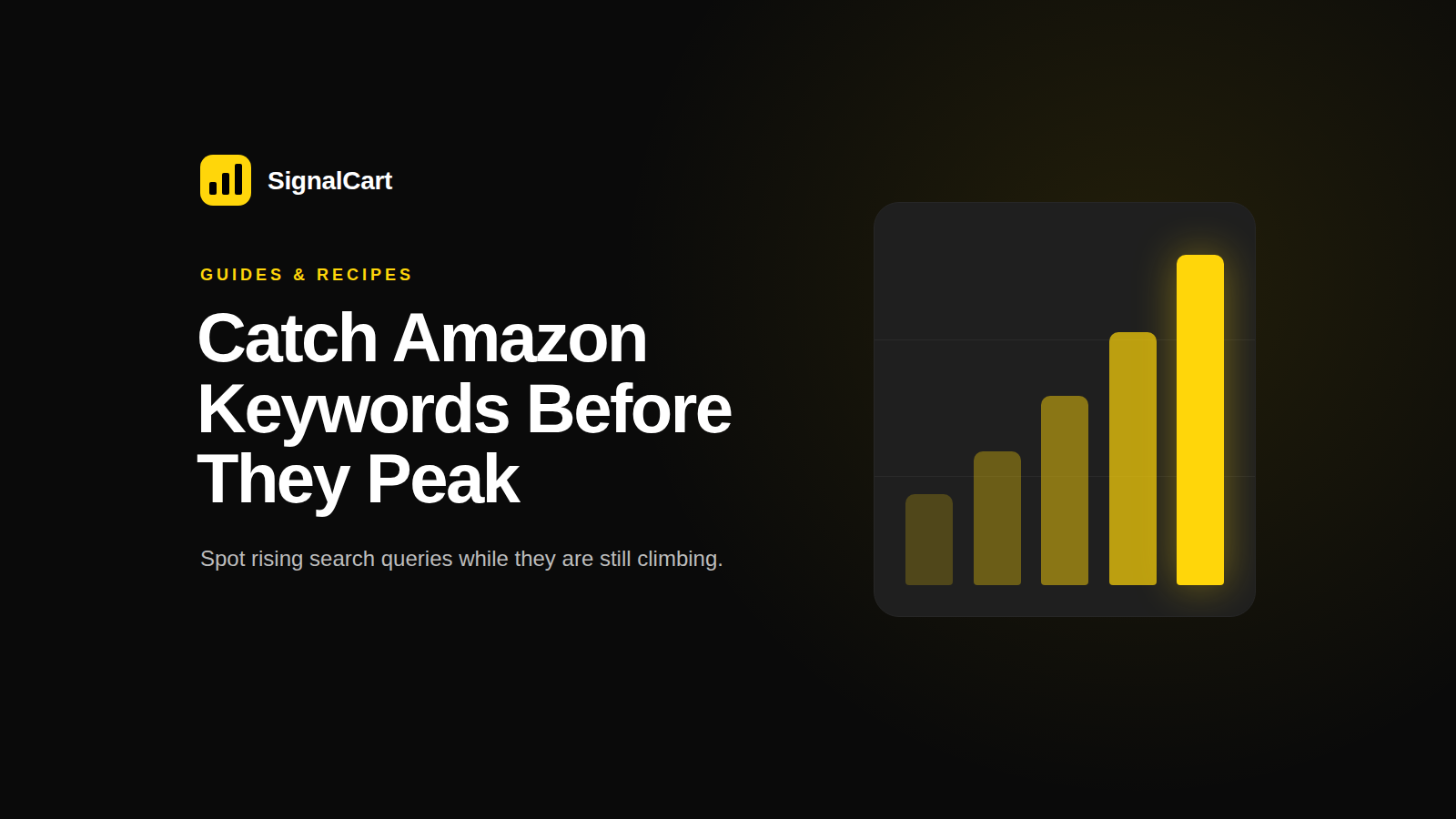
Amazon keyword ranking is a product's position for a search query at a given moment, but its value lies in the delta: rank velocity on accelerating queries reveals demand before it peaks. Track position jumps alongside TikTok, Instagram, and YouTube signals to adjust listings, PPC bids, and inventory in time.
Amazon keyword ranking is a product's position for a specific search query at a specific moment — and the reason to track it is not the position but the delta: how fast a query is climbing before it peaks. Static rank trackers answer "where am I today." A rising-query system answers "where is demand going next," and only the second question leaves you enough time to adjust a listing, a PPC bid, or an inbound PO. This article treats Amazon keyword ranking as one input in a demand-detection pipeline, then shows how to wire that pipeline to cross-platform signals from TikTok Shop, Instagram, and YouTube using SignalCart's public-data API.
Why Amazon Keyword Ranking Is a Lagging Indicator — and Rising Queries Are the Leading One
A rank position is an outcome. By the time an ASIN sits at position 3 for a high-volume query, competing sellers have already seen it, ad auctions have already priced it, and suppliers have already quoted against it. The information is public, cheap, and therefore mostly priced in.
Query velocity is different. A keyword that jumps from position 61 to position 22 over nine days, on a query with modest but accelerating volume, is a cause rather than an outcome. It usually reflects one of a small number of events: a listing change that started matching intent, a creator video that pushed external traffic into the query, a competitor going out of stock, or a genuine seasonal curve starting earlier than the category norm.
The commercial stakes are straightforward. Sellers who detect a rising query two weeks early can reprice, raise exact-match bids before CPC inflation, restock the variant that matches the query language, and rewrite title and bullet copy to match the new phrasing. Sellers who detect it two weeks late are bidding against everyone who already noticed, into a keyword pool that has become expensive and crowded.
SignalCart's position on this is deliberately narrow: Amazon keyword ranking should be one sensor in a broader demand-detection system, not a standalone scoreboard. The same API surface that returns Amazon rank data also returns TikTok Shop product and creator data, Instagram and YouTube creator intelligence, and trend signals through SignalCart Trends, all drawn from public data only. The point is not that one platform predicts another perfectly — it is that demand usually leaves a trail across several surfaces before it shows up as an Amazon search ranking.
What a Rising Search Query Looks Like in Amazon Keyword Ranking Data
Signals worth monitoring
Sudden rank jumps. A rank improving by more than a category-normal band within a short window. The signal is the magnitude relative to the query's own volatility, not an absolute position.
New keyword emergence. Queries that did not exist in your tracked set last month but now return a stable set of ASINs. New phrasing often precedes new demand.
Autocomplete changes. What Amazon suggests after a two-word seed is a cheap, high-frequency proxy for intent shifts; capturing it on a schedule gives you query discovery without guessing.
Seasonality curves. A query that historically peaks in week 46 but is already accelerating in week 38 is a leading indicator that the curve shifted.
Sponsored-versus-organic divergence. When sponsored rank improves while organic rank stagnates, you are watching paid placement buy visibility rather than genuine relevance. When organic improves while sponsored holds, something else — usually external traffic or a listing change — is doing the work.
Separating durable demand from noise
A rank delta on its own is a weak signal. Validate it against at least three things before you spend money:
Search volume direction. Learn to compare absolute Amazon search volume with relative trend indexes: rising rank on a shrinking query is noise, while rising rank on a flat or growing query is a candidate.
Conversion proxies. Review velocity and rating changes on the top ASINs for the query tell you whether the traffic converts. The Amazon Reviews API collects ratings and feedback at scale and automates sentiment analysis, which helps explain why a query is heating up rather than only that it is — a distinction that matters when a rise is driven by complaints about an incumbent rather than by genuine new appetite.
Repeat appearances across marketplaces. A query moving in both US and DE is a structural shift. A query moving only in US is more likely a single campaign.
Keep the underlying record normalized. A rank check has to be tied back to structured ASIN data — title, price, image, rating — so store rank observations alongside a resolved product record. SignalCart's ASIN API returns exactly those fields for a single ASIN, which is the join key your rank history table needs.
Cross-platform spillover
Social demand frequently runs ahead of Amazon search demand. A creator video that drives a spike in TikTok Shop GMV for a category will often produce Amazon query growth days to weeks later, as buyers re-search the product name on a marketplace they already trust. Treat TikTok Shop trending products, creator GMV acceleration, and engagement rates as upstream of Amazon keyword ranking, not as separate reporting silos — and learn to extract trend signals from public social data so that upstream layer is something you can actually query.
How to Evaluate Amazon Keyword Rank Trackers: A Commercial Buyer's Checklist
Before comparing tools, define what the tool must produce. A tracker that cannot support the following is a scoreboard, not a detection system.
Organic and sponsored rank history. Separate series, stored over time, not just today's position. Without history you cannot compute a delta, and without a delta you cannot detect a rising query.
Keyword discovery. The ability to surface queries you did not seed — via autocomplete capture, competitor ASIN reverse lookup, or search-term imports.
Marketplace coverage. At minimum, every marketplace where you actually sell. Cross-marketplace comparison is where noise and structure separate.
Refresh frequency and its cost. Higher frequency reduces detection lag and increases spend. The optimal polling frequency for a given query before it peaks is not established in the available sources — so treat frequency as a tuning parameter you test against your own category.
Export and API access. If the data cannot leave the tool, it cannot join your warehouse, your dashboards, or your alerting.
Data provenance. Know whether the vendor collects public data directly, licenses it, or estimates it.
Tool categories, not brand names
Browser extensions are fast for one-off checks and useless for history. Free rank checkers are useful for validating a single keyword and unreliable at scale. Seller suites such as Jungle Scout and Helium 10 bundle keyword research, rank tracking, and sales estimation into a workflow aimed at individual sellers. Data APIs — SignalCart is one — sell structured records rather than screens, which makes them the right layer when you need to join Amazon keyword ranking to TikTok Shop analytics, creator GMV, or your own internal sales data.
The comparison axes that actually matter are coverage, pricing model, and reliability, and they resolve differently depending on whether the buyer is a seller, a developer, or an agency. A seller optimizing margin cares about refresh frequency per dollar. A developer cares about schema stability and rate limits. An agency cares about multi-account coverage and export rights.
The Semrush question
Buyers often ask whether web SEO platforms can substitute for Amazon-native rank data. They cannot. Semrush and similar Google Trends alternatives are strong for web search trends, backlink data, and Google-side query behavior, and that is useful context for brand-level demand. But Amazon search is a different index with different ranking factors, different autocomplete, and ASIN-level result pages. A web keyword tool can tell you a term is trending on Google; it cannot tell you which ASIN holds position 7 for that term on Amazon US this morning. Use them as complements, never as substitutes.
Beyond Amazon: Tracking Trending Products on TikTok Shop and Social Platforms
The leading edge of demand is usually visible on social commerce first. SignalCart's TikTok Shop product telemetry exposes acceleration and creator attachment at the product level, which is the closest available analogue to a pre-peak query curve.
Product | Category | GMV 30d (USD) | Acceleration % | Creator num |
|---|---|---|---|---|
Pokemon 30th Celebration Booster Packs (RIP LIVE) | Home & Living | $11,167 | 299.9% | 1 |
12x20ft Enclosed Metal Carport Garage Outdoor Storage Unit - Heavy-Duty Steel... | Home & Living | $76,778 | 299.8% | 5 |
Real Pearl Jewelry Customize on Live Yvonne Design | Home & Living | $25,477 | 299.8% | 4 |
HHR Divisional Break | Home & Living | $13,333 | 299.3% | 1 |
Women's WIHOLL 2-Piece Casual Lounge Set, Fashion Fall Outfits Pants & Top Set | Women's Clothing & Shoes | $11,668 | 299.1% | 44 |
Women's High-Waisted Wide Leg Bottoms - Business Casual Drape Trousers with C... | Home & Living | $10,728 | 298.7% | 14 |
1/2 Pcs Women's Molded Cup Seamless Smooth Tank Top, U Shape Wide Strap Back ... | Women's Clothing & Shoes | $27,882 | 297.9% | 168 |
Halara UltraSculpt™ High Waisted Stretchy PU Tummy Control Yoga Leggings with... | Women's Clothing & Shoes | $16,902 | 296.8% | 20 |
Pacsun Women's Zoe Low Rise Girlfriend Jeans Light Blue Wash | Home & Living | $53,718 | 296.6% | 95 |
【AOPO】Motorized Scooter for Adults - 350W Motor, 36V Battery, Max 19mph Speed... | Home & Living | $51,607 | 294.8% | 48 |
Trending social commerce products with recent sales acceleration and creator activity. Source: SignalCart Data (TikTok Shop US products, data as of 2026-11-02).
Read the table as a query-generation list, not a leaderboard. The Women's WIHOLL 2-Piece Casual Lounge Set posted GMV 30d of $11,668 with 299.1% acceleration across 44 creators — that combination of acceleration and creator breadth is precisely the pre-peak curve a rank tracker is meant to catch, and the product-name tokens ("lounge set," "two piece," "fall outfits") are candidate Amazon seeds. The 1/2 Pcs Women's Molded Cup Seamless Smooth Tank Top is a stronger example still: GMV 30d of $27,882 at 297.9% acceleration with 168 creators attached, versus low single-digit creator counts on other rising items in the same snapshot. Creator count is a leading indicator that often runs ahead of search ranking.
Engagement-side data adds a second layer: which creators and formats are producing the attention that will convert into marketplace searches.
Video | Handle name | Category tag name | Engagement rate 30d | Total views 30d |
|---|---|---|---|---|
The salon secret from @Realericvaughn came home with me. 5 minutes for the gl... | mar.hacks | All Categories | 57.9% | 33,865 |
Walk into work with me @Garage Clothing #garagepartner #iweargarage #manager ... | savorgabrielle | All Categories | 76.5% | 5,402 |
#ad protein s’mores made two ways with @Naked Nutrition ✨🍓 recipe below: str... | nutritionwithnat_ | All Categories | 73.3% | 5,172 |
If you also want to upgrade your car to wireless CarPlay, this is a good choi... | kress.scare8 | Technology & Finance | 21.3% | 38,940 |
Social videos featuring trending products, brand partnerships, and shoppable moments from creators.. Source: SignalCart Data (TikTok top videos).
Marketers and agencies use this layer to spot products gaining social traction before Amazon search demand catches up. A creator with a 76.5% engagement rate on a narrow audience is a stronger early signal for a niche query than a high-view video with ordinary engagement, because the conversion path to a marketplace search is shorter.
Building a Rising-Query Workflow with SignalCart Trends and the SignalCart API
The workflow has five stages, and each one maps to a layer you can run separately.
Seed. Start from a keyword set derived from your catalog, competitor ASINs, and TikTok Shop trending product names. One hundred to three hundred seeds is usually enough to cover a category; more than that and alert fatigue sets in before signal does.
Monitor rank deltas. Poll rank history on a schedule and compute deltas over fixed windows rather than comparing to a single previous observation.
Flag rising queries. Apply a threshold relative to each query's own volatility — a query that normally moves two positions should not alert at three, and a query that normally moves twenty should.
Validate demand. Check the flag against review velocity, rating drift, price movement, and repeat appearances across marketplaces — and against sales, since teams that spot demand trends with real-time Amazon sales data usually see the shift before rank reprices it. A price monitoring API that tracks real-time price changes with alerting across marketplaces is a useful cross-check: cascading price cuts alongside a rising query usually mean a promotional push, not organic demand.
Trigger actions. Route validated flags to listing copy updates, PPC bid rules, or inventory review — with a human gate on the first two weeks of automated output.
SignalCart Trends surfaces emerging search and product behavior; the SignalCart API feeds dashboards, alerts, and product-research tools. The two are meant to be used together: Trends for discovery, the API for the repeatable query.
Illustrative payloads
Request (illustrative): GET /v1/amazon/keywords/history?seed=seamless+tank+top&marketplace=US&window=30d
Response (illustrative, truncated): {"seed":"seamless tank top","marketplace":"US","rows":[{"asin":"B0XXXXXXX","rank_organic":14,"rank_delta_7d":-9,"rank_sponsored":3,"observed_at":"2026-11-01"}]}
Request (illustrative): GET /v1/tiktok-shop/products/creators?query=seamless+tank+top®ion=US&window=30d
Response (illustrative, truncated): {"query":"seamless tank top","creator_count":168,"gmv_30d":27882,"acceleration_pct":297.9,"as_of":"2026-11-02"}
These payloads are illustrative only — field names, paths, and shapes are examples and not a documentation contract. Confirm actual parameters, pagination behavior, and quota limits against the SignalCart docs before building against them.
Operating notes for developers
Rate limits and backoff. Expect 429 responses under burst polling. Honor any retry-after header, apply exponential backoff with jitter, and cap concurrency per marketplace.
Error classes. Treat 400 as a schema or parameter bug on your side, 401/403 as credential or scope problems, 429 as pacing, and 5xx as retryable with backoff. Never retry a 400 — you will burn quota reproducing the same failure.
Idempotency and storage. Store observations keyed on (query, marketplace, ASIN, observed_at) so re-fetches do not double-count. A pipeline of collect → store cleanly → visualize in dashboards is the minimum viable shape; a one-off scrape will not survive a month of monitoring.
Trade-off. Polling more often shortens detection lag and raises cost and noise in equal measure. Start weekly, tighten to daily only on the seeds that earn it.
A lightweight weekly job
A workable pattern for a small agency or a solo developer: pull rank history for a 50-keyword seed set, compute a seven-day delta per query, join each query to its TikTok Shop creator count and GMV acceleration, score the result, and export a CSV of the top twenty movers every Monday. The join key is the product-name token, not the ASIN — Amazon ASINs and TikTok Shop product IDs do not overlap, so normalize names into shared tokens before joining. Roughly half a day of engineering, and it produces a defensible weekly opportunity list that a rank-tracker screenshot cannot.
Common Mistakes and a 30-Day Action Plan for Amazon Keyword Ranking Monitoring
The failure modes are consistent across teams:
Tracking too many keywords. Thousands of seeds produce thousands of alerts and no decisions. Coverage is not the goal; triage is.
Ignoring sponsored rank. Organic-only tracking misses paid-driven visibility entirely, and sponsored-only tracking mistakes budget for demand.
Overreacting to short-term noise. A one-day rank swing is not a trend. Require the signal to persist across at least two observation windows.
Failing to connect rank changes to inventory or ad spend. A rising query you cannot service is a competitor acquisition event. Route flags to whoever owns stock and whoever owns bids.
Treating a rank tracker as an answer. It is a sensor. The decision layer needs cross-platform context.
A 30-day plan
Week 1 — baseline. Build a 50–200 keyword seed set from your catalog, your top competitors' ASINs, and current TikTok Shop trending product names. Capture 30 days of rank history where available and store it in a normalized table.
Week 2 — rising-query alerts. Add delta-based flagging relative to each query's own volatility. Tune thresholds until the daily alert list is short enough to read.
Week 3 — social layer. Join Amazon rank movements to TikTok Shop creator counts and GMV acceleration, plus Instagram and YouTube creator intelligence where relevant. Start marking which flags preceded actual Amazon rank movement — that is your calibration set.
Week 4 — review and refine. Cut seeds that never moved, tighten thresholds that over-fired, and formalize the handoff to listing, PPC, and inventory owners. Publish one weekly opportunity list and hold the format stable.
The tool-selection takeaway is simple. Choose a rank tracker for the history it stores and the freshness it delivers, then pair it with a rising-query and cross-platform data layer so you are acting before the peak rather than reporting on it afterwards. A single API spanning Amazon, TikTok Shop, Instagram, and YouTube — public data only — is the pragmatic way to keep both halves of that system on one schema.
FAQ
What tool is best for finding rising search queries on Amazon?
There is no single best tool; combine Amazon Brand Analytics search term reports with rank trackers that expose velocity (Helium 10, Jungle Scout) and an API layer like SignalCart that maps cross-platform signals to Amazon queries. The best setup flags rank deltas over 7–14 days rather than static positions.
How can I track trending products on TikTok and Amazon?
Monitor TikTok hashtag and product-level engagement velocity through TikTok Shop or a public-data API, then match those rising terms to Amazon keyword rank deltas for the same queries. Correlating external traffic spikes with rank jumps separates genuine demand from noise.
Does Semrush provide real-time search trend data?
Semrush offers keyword and trend data refreshed daily or weekly, not true real-time streams. Use it for search-demand context and volume estimates, and pair it with rank trackers for intraday Amazon position deltas.
How do I detect a rising Amazon keyword before it peaks?
Track rank movement over 7–14 days relative to query volume growth, flagging queries that climb fast on modest but accelerating volume. Confirm the signal with external traffic from TikTok, Instagram, or YouTube before adjusting bids or inventory.

by Marcus Reed, Data Infrastructure & API Editor
Marcus Reed writes about the engineering work behind reliable commerce data: API selection, schema normalization, pagination, collection pipelines, and data warehousing. His guides focus on trade-offs developers face when building versus buying data infrastructure, including refresh cadence, failure handling, and maintenance. The aim is to help technical teams move from scattered platform outputs to consistent datasets they can query and maintain.